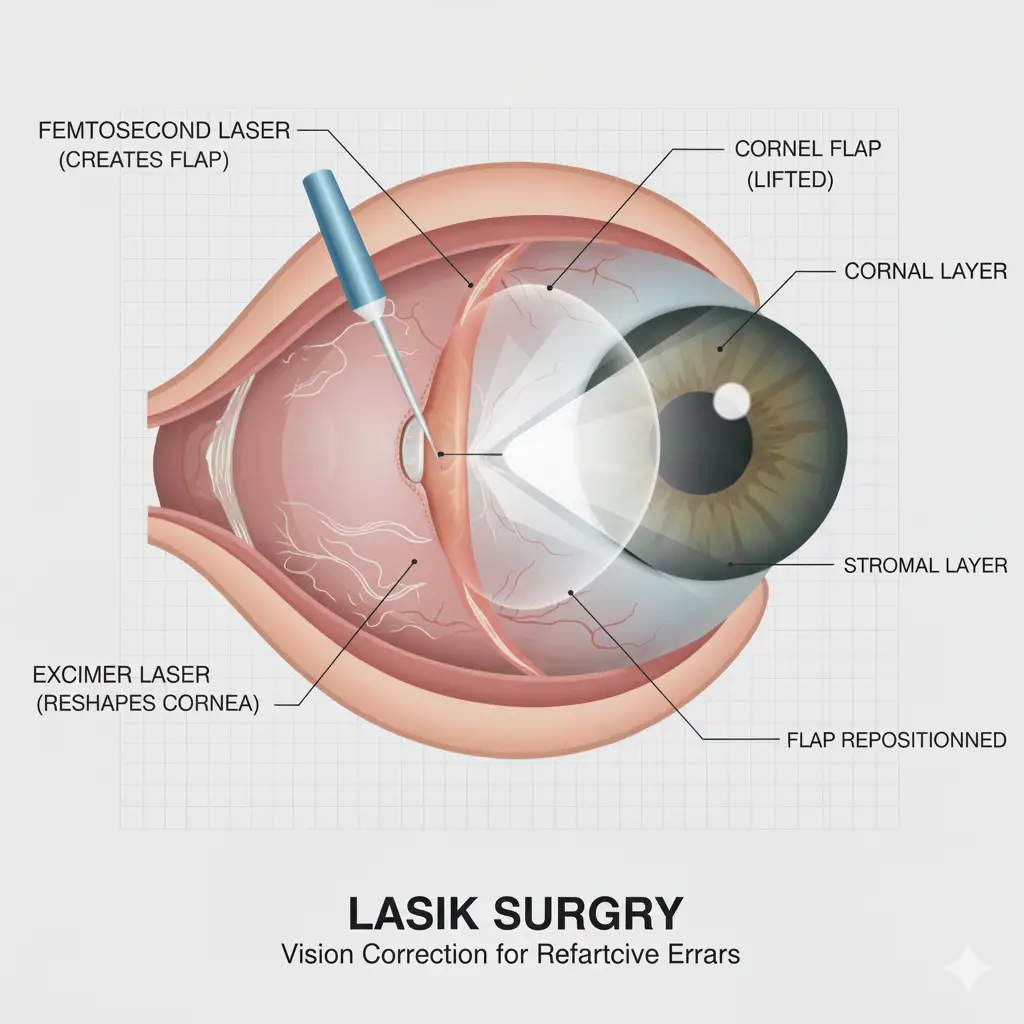
LASIK (Laser-Assisted In Situ Keratomileusis) is one of the most advanced and popular laser vision correction treatments used to reduce or eliminate the need for glasses and contact lenses. It reshapes the cornea with high-precision laser technology so that light focuses correctly on the retina, improving vision.
Millions of people worldwide choose LASIK every year for its quick results, minimal discomfort, and long-term clarity.
What Is LASIK Surgery?
LASIK is a refractive eye surgery designed to correct:
- Myopia (Nearsightedness)
- Hyperopia (Farsightedness)
- Astigmatism
- Higher-order aberrations (in some cases)
During LASIK, a thin corneal flap is created, and a laser reshapes the underlying tissue to improve the way light enters the eye.
Who Is an Ideal Candidate for LASIK?
LASIK is suitable for people who:
- Are 18 years or older
- Have a stable eye prescription for at least one year
- Have healthy corneas with sufficient thickness
- Do not have active eye diseases like keratoconus, severe dryness, or infections
- Are not pregnant or breastfeeding
A thorough eye evaluation determines if LASIK is the right choice.
How LASIK Surgery Works: Step-by-Step
1. Eye Numbing
Anesthetic eye drops ensure a painless experience.
2. Corneal Flap Creation
A femtosecond laser creates a very thin flap on the cornea.
3. Corneal Reshaping
An excimer laser reshapes the cornea based on your prescription to improve vision precision.
4. Flap Replacement
The flap is gently repositioned. It naturally seals itself—no stitches required.
Total time per eye: 10–15 minutes
Most patients notice vision improvement within 24 hours.
Benefits of LASIK Surgery
- Clear vision without glasses or lenses
- Fast, painless recovery
- Long-term results
- Safe and highly accurate due to computer-guided lasers
- High patient satisfaction
- Minimal downtime—return to routine in 24 hours
In many cases, LASIK provides 20/20 or even better vision.
Is LASIK Safe?
Yes, LASIK is considered extremely safe when performed by experienced surgeons using modern technology. Complications are rare and usually temporary, such as:
- Mild dryness
- Light sensitivity
- Halos at night
- Temporary blurred vision
Most side effects resolve within weeks.
Recovery After LASIK
What to Expect
- Mild irritation for a few hours
- Blurry vision that improves quickly
- Stabilization of vision within a few days
Post-Surgery Care
- Avoid rubbing your eyes
- Use prescribed eye drops
- Wear protective eye shields while sleeping
- Avoid swimming, makeup, or dusty environments for about a week
Following these instructions ensures smooth healing.
Modern LASIK Technologies
Many hospitals now use advanced versions of LASIK for superior outcomes:
- Bladeless (Femtosecond) LASIK
- Contoura Vision LASIK
- SMILE (Small Incision Lenticule Extraction) – flapless procedure
- Wavefront-guided LASIK – customized to eye’s unique optics
These technologies increase safety and precision while reducing recovery time.
Who Should Avoid LASIK?
LASIK may not be recommended for patients with:
- Keratoconus or thin cornea
- Severe dry eye disease
- Uncontrolled diabetes
- Autoimmune diseases
- Very high power beyond the safe laser correction limit
Such patients may benefit from ICL (Implantable Contact Lens) or PRK instead.
Final Thoughts
LASIK continues to be one of the safest and most effective procedures for permanent vision correction. With quick recovery, minimal discomfort, and life-changing results, it is an excellent option for anyone wanting freedom from glasses or contact lenses. A detailed eye evaluation by an experienced eye specialist will determine whether LASIK is suitable for you.
Need Expert Medical Advice?
Our team of experienced doctors is here to help you with any health concerns.
Book Appointment